Space
Voyager 1: One Light-Day From Home
— Written by admin in Space
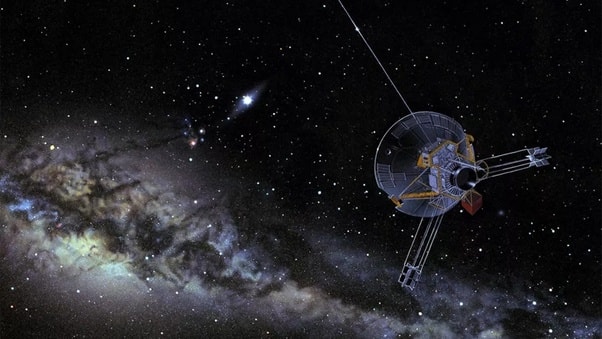
At 5:16 this morning, November 18, 2026, Voyager 1 became the first human-made object to reach one light-day from Earth — 25.9 billion kilometres away, about 173 times the distance from Earth to the Sun. Launched on September 5, 1977, the spacecraft has now been flying for 49 years, two months and 12 days, and no object built by human hands has ever been this far from home.
One light-day is a distance measured in time: it is how far light travels in 24 hours. A radio signal from Earth now takes a full day to reach Voyager 1, and its reply takes another full day to come back, so every exchange between NASA's Jet Propulsion Laboratory and the spacecraft is a two-day conversation. The milestone itself is symbolic — nothing changes on board as it crosses the line — but it is a measure of just how far the little probe has come.
Voyager 1 was built for a grand tour of the outer planets, flying past Jupiter in 1979 and Saturn in 1980 before heading out of the plane of the planets and on toward the edge of the Solar System. It crossed the termination shock, where the supersonic solar wind slows abruptly, in December 2004, and entered interstellar space in August 2012, the first spacecraft ever to do so. It is still coasting outward at about 17 kilometres per second, through a thin plasma the Sun's wind has never touched.
Remarkably, it is still working. Only two of its ten science instruments remain switched on — the magnetometer and the plasma wave instrument — and its plutonium generators lose about four watts of power every year, but the data keeps coming. Its transmitter puts out roughly 23 watts, about the same as a refrigerator bulb, and the signal still reaches Earth across 25.9 billion kilometres of space.
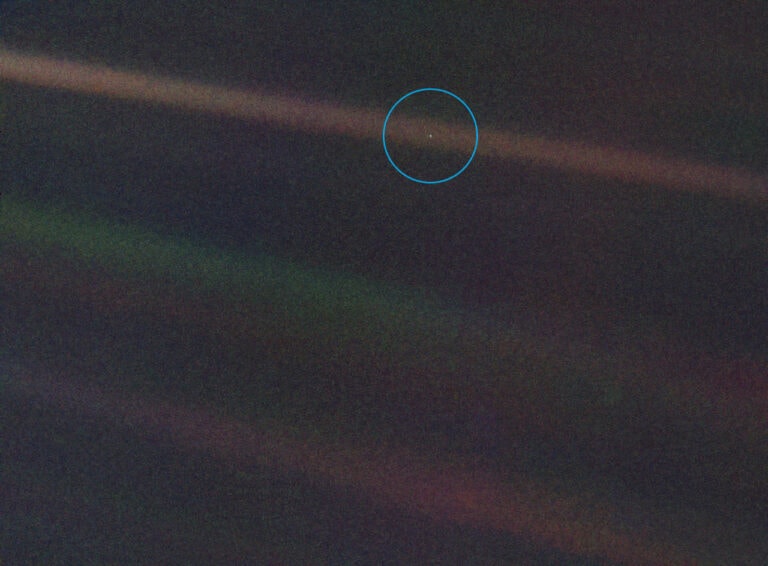
For all that distance, Voyager 1 has covered only about one fifteen-hundredth of the way to the nearest star, and at its current pace it would take some 18,000 years to travel a full light-year. Its twin, Voyager 2, is not expected to reach one light-day until November 2035. In about 40,000 years Voyager 1 will pass near the star Gliese 445 — still 1.7 light-years away from it. The probe that took the Pale Blue Dot photograph of Earth in 1990 is now a light-day from home, and still going.