Woodstock History
How Woodstock Got Its Name
Woodstock was nearly called Brighton.
Before any of us got here, the site was already a crossroads — the Detroit Path, an ancient Indigenous trade and travel route, ran through what's now Oxford County. In 1793, Lieutenant Governor John Graves Simcoe passed through, took one look at the elevated ground above the Thames, and marked it a suitable "Town Plot."
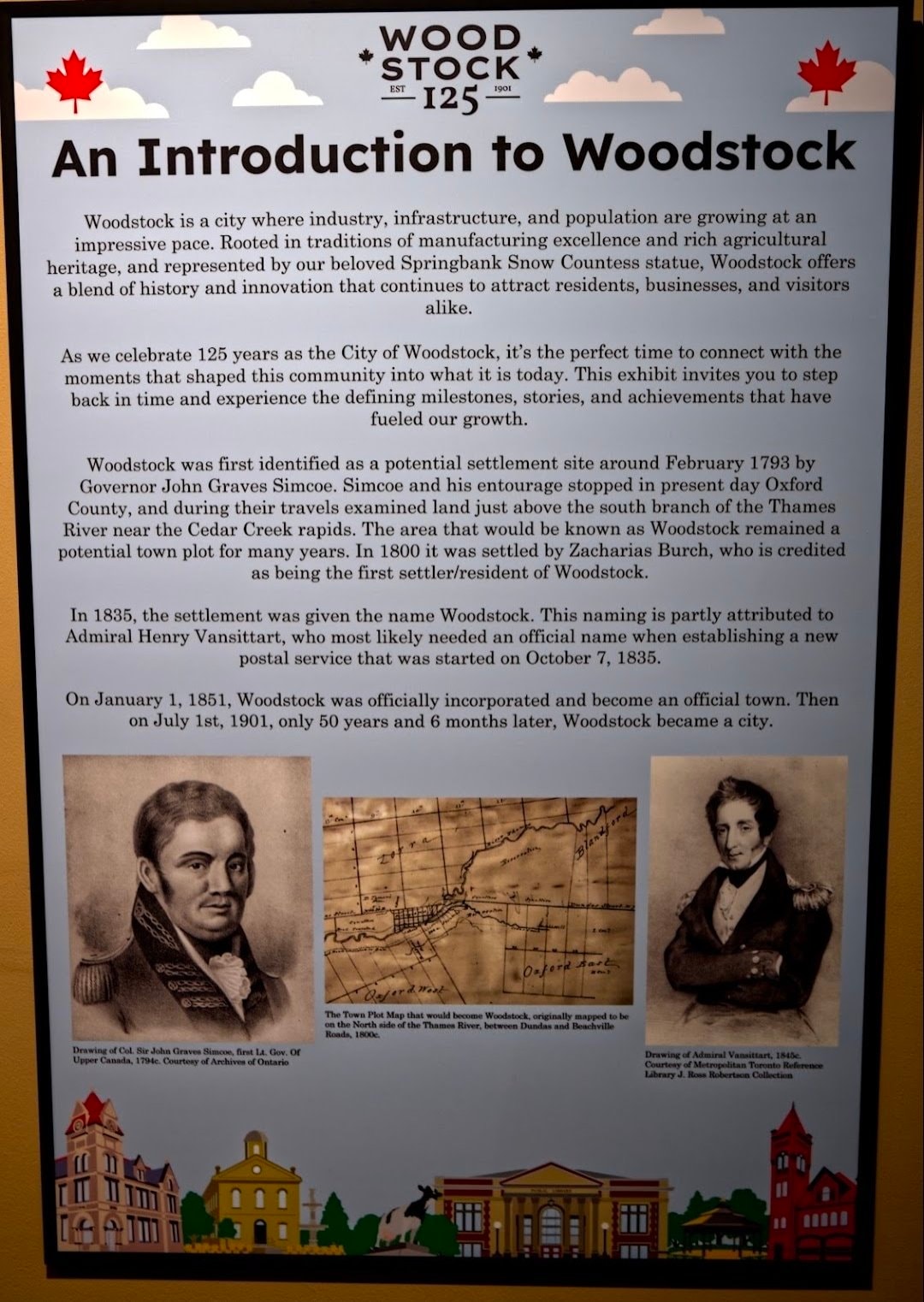
Settlement began in 1800, when Zacharias Burtch and Levi Luddington arrived from New York and took up land. By most accounts, that's the founding date — but the place that would become Woodstock was still just a rough clearing.
The real transformation came in the 1830s, and it was a deliberate piece of empire-building. British naval and army officers, put on half-pay after the Napoleonic Wars, were looking for a new start in the colonies — and the Crown was keen to seed the region with settlers loyal to Britain rather than American immigrants.
Enter Rear Admiral Henry Vansittart. In 1832 he formed a partnership with Captain Andrew Drew, a fellow naval officer on half-pay, putting up £1,800 to develop a farming estate in Upper Canada. Drew sailed first. He took up land in Blandford Township, had Charles Rankin survey the town plot, divided the eastern section into lots, erected the first church — Old St. Paul's — with Vansittart's money, and built some of the first houses. Drew's own house went up in 1833; it still stands at 735 Rathbourne Avenue.
When Vansittart himself arrived in 1834, the partnership blew up almost immediately. The Dictionary of Canadian Biography tells the story: all the land was held in Drew's name, Drew wouldn't hand over the church over disputed construction money, and some of Drew's investments on Vansittart's behalf didn't meet with approval. They quarrelled; the partnership was dissolved by arbitration. It was a falling-out with consequences — Drew's church became "Old St. Paul's" and the congregation eventually built a second church, "New St. Paul's."
But Vansittart stayed, and he left his name on the place in two ways. He named the village Woodstock, for Woodstock in Oxfordshire, England, where he'd been educated — the name became official the following year, when the post office opened on October 7, 1835 — and a century and a half later, his name still runs down the west end of the city on Vansittart Avenue.
The numbers tell the rest. About 200 people lived here in 1836. By 1844, nearly 1,000. The 1851 census counted 2,112 people in 287 houses; on January 1, 1851, Woodstock officially became a town, and the first town meeting was held that January in the Royal Pavilion Hotel. It became a city on July 1, 1901.
As for Drew — he didn't fade quietly into town history. In 1837, during the Upper Canada Rebellion, he led the raid that seized and burned the American steamer Caroline in the Niagara River, an incident still studied in international law classes. His house carries a heritage plaque naming him co-founder of Woodstock alongside Vansittart.
Two villages a mile apart, a swamp in between, a squabbling admiral and his agent — that's how a town plot on Simcoe's map became Woodstock.